

DRONE SOCCER
Rules and Regulations
What is Drone Soccer?
Drone Soccer is an innovative and emerging sport within the realm of Information and Communication Technology (ICT). It represents a novel and exciting development in the world of competitive activities, as it has recently been introduced to the public and gained recognition as a new form of recreational sport that combines the elements of drone technology with traditional team-based gameplay. The concept was initially brought to market or made available to a broader audience for the very first time on a global scale, marking its debut as a commercially accessible activity.
The primary objective behind the commercialization of Drone Soccer was to establish a fun, engaging, and inclusive leisure sport that can be enjoyed by people of all ages and genders, breaking down barriers that often limit participation in certain traditional sports.
By designing it as an accessible and universally appealing activity, the creators aimed to foster a new avenue for entertainment, physical activity, and social interaction, making drone-based sports more approachable and enjoyable for everyone, regardless of their background or skill level.
Class 40
Skyfence
The stadium should be rectangular, with one side measuring 7m and the other side measuring 16m, maintaining a ratio as close as possible to 2:1 between the longer and shorter sides.
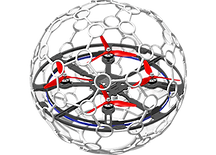
The Drone Ball
Structure: A spherical outer structure
Diameter: About 40cm ±2cm
Weight: Less than 1,100g (Battery and receiver included)
Feature: Distinguishable by LED lights
Goal
A round goal with an inner diameter of 60cmdes.


Class 20
Skyfence
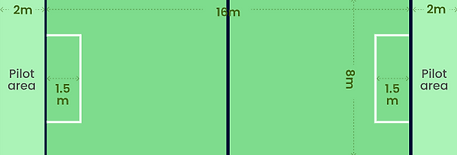
The stadium should be rectangular, with one side measuring 4m and the other side measuring 8m, maintaining a ratio as close as possible to 2:1 between the longer and shorter sides.

The Drone Ball
Structure: A spherical outer structure
Diameter: About 20cm±1cm
Weight: Less than 110g
Feature: Distinguishable by LED lights
Goal
A round goal with an inner diameter of 30cm.

Game Rules
Player
Each team consists of 5 players, aiming to control the drone ball, score goals, and defend their own goal. Only the striker is allowed to score.
-
Each team should have 5 players as a general rule.
-
A match can proceed normally with a minimum of 3 players at the start of a set.
-
Only the striker is allowed to score.
-
If the striker is unable to continue playing, the guide can take over the striker's role after the striker formally declares forfeiture and the head referee approves it.

Score
A goal is counted when the striker's drone ball fully enters the goal from the front to the back.
However, if the player is offside, the score will not be counted, even if the ball fully enters the goal.
Additionally, if the drone ball bounces back before completely enter the goal, the score is considered invalid.

Offside
-
If the striker enters the opponent’s goal in any direction, the team is automatically offside and cannot attempt to score.
-
To clear the offside, all players must return behind the half-line to their team’s area.
-
If a drone ball remains uncontrolled in the opponent’s area, offside is not cleared until the player announces set abandonment and puts down the controller.
A penalty may be given in the following situations:
-
Scoring consecutive goals while ignoring offside rules.
-
Entering through one's own goal in reverse.
-
Receiving two or more *warnings from the referee
The number of warnings is tracked throughout the game but resets for the next game.
Penalty Kick Method
-
When: At the end of each set.
-
How: A 1:1 match between the striker and keeper.
-
Duration: 5 seconds per penalty kick.